
Tyne and Wear · NE postcodes
Fire Damper Testing in Washington
Fire Damper Testing in Washington for restaurants, takeaways, pubs, schools and workplace kitchens across NE postcodes.
Fire Damper Testing in Washington: what to expect
Fire damper testing checks that the dampers in your ductwork will close and hold back fire and smoke. We find each damper, release it, check it closes fully, clean it, reset it and record its location, condition and result in a damper register.
In Tyne and Wear, a lot of extract fans sit on flat roofs or in rear yards that are rarely checked. We include the fan in every full clean and note its condition, so you know the whole system has been covered.
Food production units and central kitchens near Washington can need cleaning more often than the TR19® Grease minimum, so we use test results to set the interval.
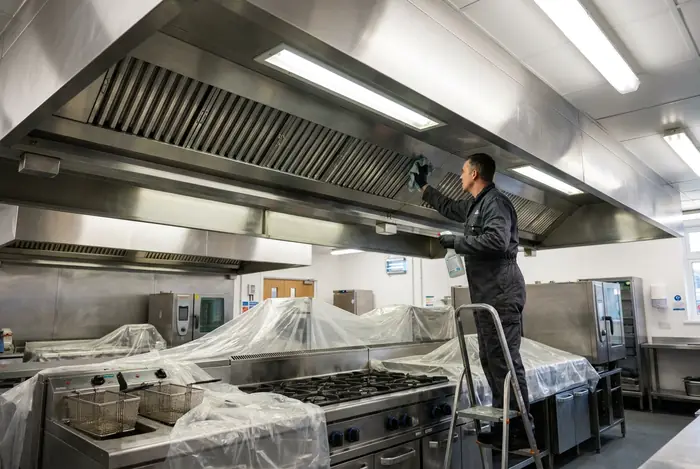
Each visit begins with sheeting the cooking line, isolating the fan and recording pre-clean deposit readings. Only then does cleaning start, working from the canopy outwards.
- Damper blades and frames cleaned
- Faults photographed and graded
- Report for your fire risk assessment
- Damper location survey and register
| Town | Washington, Tyne and Wear |
|---|---|
| Postcode area | NE |
| Nearest covered town | Chester-le-Street (4 miles) |
| Guide price | Typically £15 to £40 per damper depending on access and numbers on site. |
From Washington we also cover Chester-le-Street (about 4 miles), Gateshead (5 miles) and Sunderland (5 miles), all within Tyne and Wear.
- Chester-le-Street about 4 miles
- Gateshead about 5 miles
- Sunderland about 5 miles
- Jarrow about 6 miles
- Wallsend about 6 miles
- Newcastle upon Tyne about 7 miles
Call 0800 088 6248 or use the quote tool for a guide price for Washington. More about fire damper testing.
Fire Damper Testing in Washington: questions
Do you cover Washington?
Yes. We provide fire damper testing in Washington and across NE postcodes, as well as nearby Chester-le-Street, Gateshead, Sunderland.
How often should fire dampers be tested?
BS 9999 recommends at least once a year, and at shorter intervals where dampers are exposed to dust or grease.