
South Wales · CF postcodes
Post-Fire & Insurance Cleans in Bridgend
Bridgend kitchens and buildings get the same standard from us as anywhere in the UK: tested before, cleaned, tested after, reported.
Post-Fire & Insurance Cleans for Bridgend kitchens and buildings
Busy Bridgend kitchens often run fryers and grills for long hours. That puts them in the heavy-use band, where grease builds quickly and cleaning every three months is the TR19® Grease minimum.
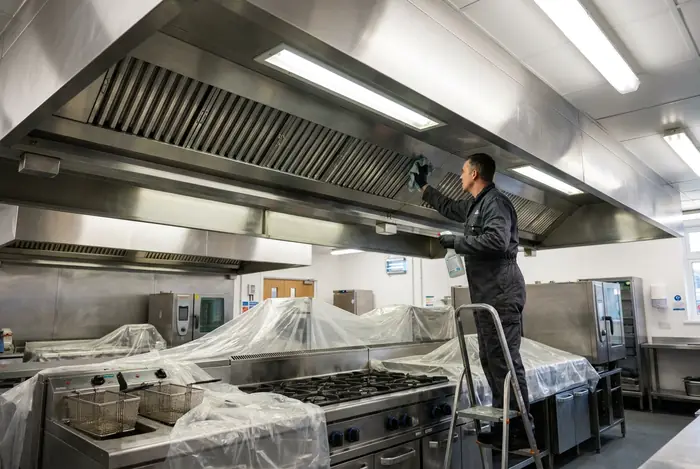
Post-fire and insurance cleans are for kitchens that need evidence quickly: a renewal deadline, a landlord request, an EHO notice or a small fire in the canopy or duct. We survey, clean what is safe to clean, and give you a report that shows the condition before and after.
A typical visit follows a set order: protect, test, clean, test again, photograph. It means the report shows exactly what changed during the clean.
For landlords and managing agents in Bridgend, we provide independent inspections where a tenant's extract passes through shared parts of a building.
- Photos of fire or smoke damage where present
- Full clean of safe sections
- List of parts needing repair before use
- TR19® Grease report and certificate
| Town | Bridgend, South Wales |
|---|---|
| Postcode area | CF |
| Nearest covered town | Port Talbot (11 miles) |
| Guide price | Priced after survey |
From Bridgend we also cover Port Talbot (about 11 miles), Pontypridd (12 miles) and Barry (15 miles), all within South Wales.
- Port Talbot about 11 miles
- Pontypridd about 12 miles
- Barry about 15 miles
- Neath about 15 miles
- Llandaff about 15 miles
- Caerphilly about 16 miles
Get a guide price online in under a minute, or call 0800 088 6248 to book a survey in Bridgend. More about post-fire & insurance cleans.
Post-Fire & Insurance Cleans in Bridgend: questions
Do you cover Bridgend?
Yes. We provide post-fire & insurance cleans in Bridgend and across CF postcodes, as well as nearby Port Talbot, Pontypridd, Barry.
Can you clean after a duct fire?
We can survey and clean, and we will list any damage your mechanical contractor or insurer needs to assess before the system is used again.